
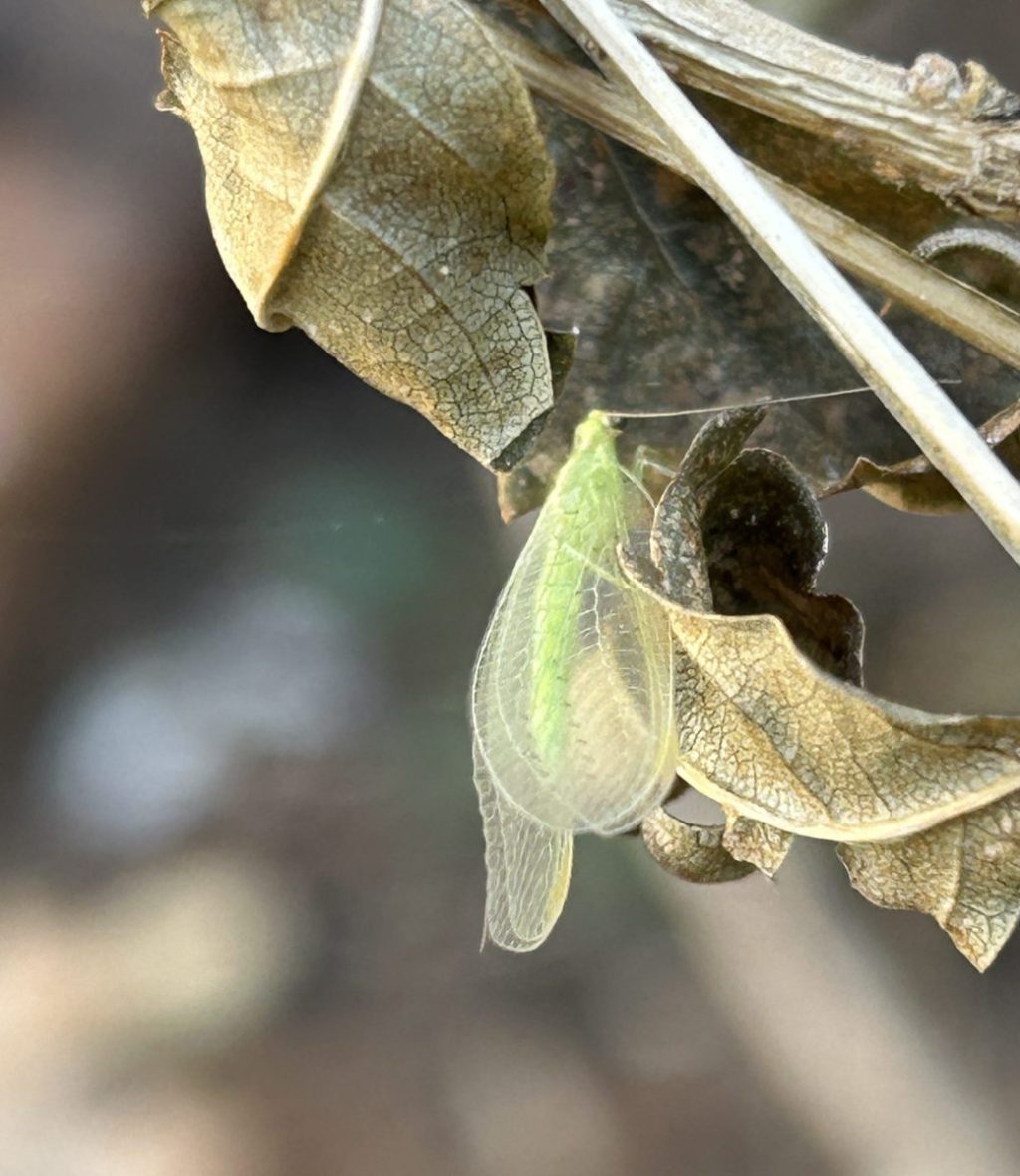
Cover photo: Green lacewings are beneficial insects that are among the first signs of ecological recovery after pesticides are removed.
Most people imagine that creating a butterfly-friendly yard starts with planting the “right” flowers. Milkweed. Coneflower. Asters. A plan.
But something quieter usually happens first.
You stop spraying.
Not dramatically. Not ceremonially. You just… don’t apply pesticides one season. Or you decide to wait and see. Or you realize you haven’t sprayed in a while and nothing terrible has happened.
And then, before the garden looks different, the insects do.
This post is about what actually happens when you stop using pesticides — especially in a typical suburban yard — and why the first butterflies you see are not the ones you expect.
The First Thing You Notice Is… Nothing
This part surprises people the most.
For weeks or even months after you stop using pesticides, nothing obvious changes.
Your lawn still looks like a lawn.
Your beds still look unfinished.
You don’t suddenly have caterpillars everywhere.
This is normal.
Insect populations don’t respond instantly to the absence of chemicals. They respond to continuity — the simple fact that the environment stays survivable long enough for them to return.
During this phase:
• Predators are still scarce
• Eggs laid elsewhere are still developing
• Adults are still testing the space, not committing to it
Ecologically, your yard is in a “probation period.”
It hasn’t earned trust yet.
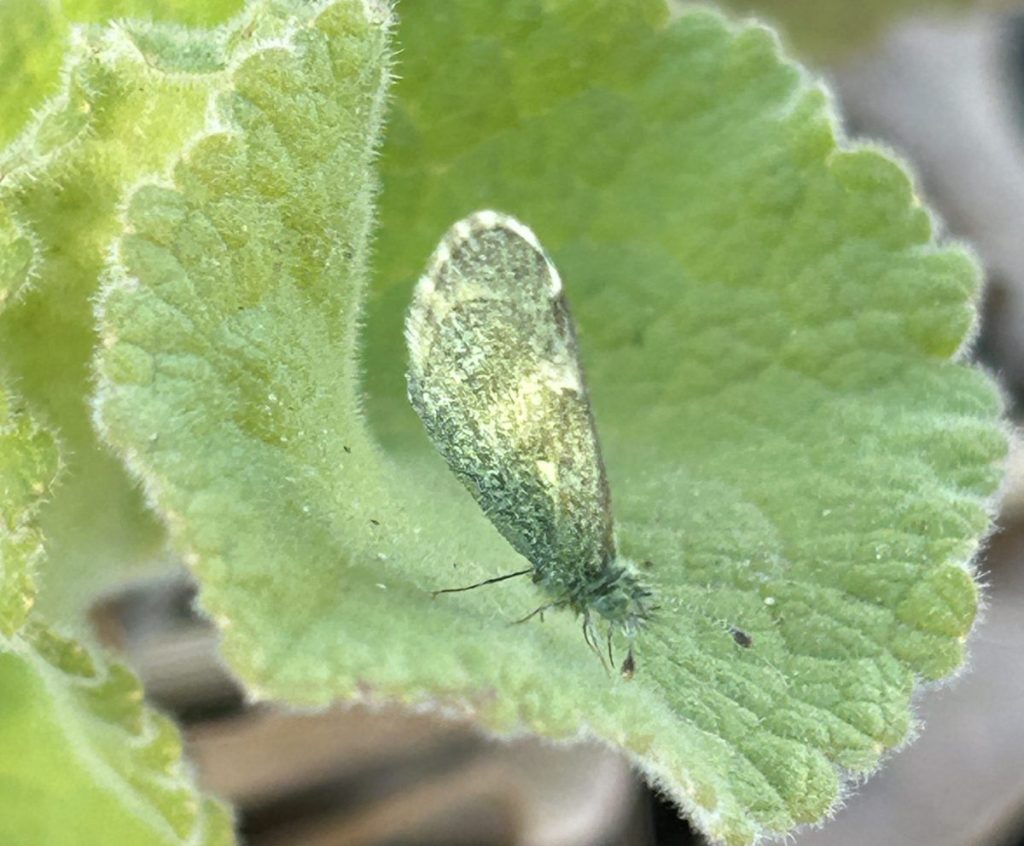
Dainty sulphur butterfly resting on a leaf in cool weather.
Then Small Butterflies Start Appearing
When butterflies do begin to show up, they’re usually not monarchs.
They’re small, subtle, and easy to overlook.
One of the most common early arrivals in Texas and the southern U.S. is the Nathalis iole, often called the dainty sulphur or little yellow. People sometimes dismiss these as “just little yellow butterflies.” But ecologically, they’re doing something important.
They’re testing the environment.
Dainty sulphurs are generalists. They tolerate:
• Fragmented habitat
• Lawns and open spaces
• Suburban edges
• Incomplete plant communities
They are often the first butterfly species to re-establish when spraying stops, because they don’t require a fully restored native landscape to survive.
Seeing them — especially repeatedly — is not random.
It’s a signal.
Why These Butterflies Show Up First
Butterflies don’t arrive all at once. They arrive in successional waves, much like plants do.
Early arrivals tend to be:
• Small
• Fast-cycling
• Flexible about habitat
• Able to use common or “weedy” host plants
Later arrivals tend to be:
• Larger
• More specialized
• Dependent on specific native hosts
• Less tolerant of disturbance
Dainty sulphurs sit firmly in the early category. They don’t need your yard to look like a prairie.
They need it to be non-toxic and predictable.
That’s why people often see them before they’ve intentionally planted host plants — and why they sometimes appear even when the garden feels “not that far along.”
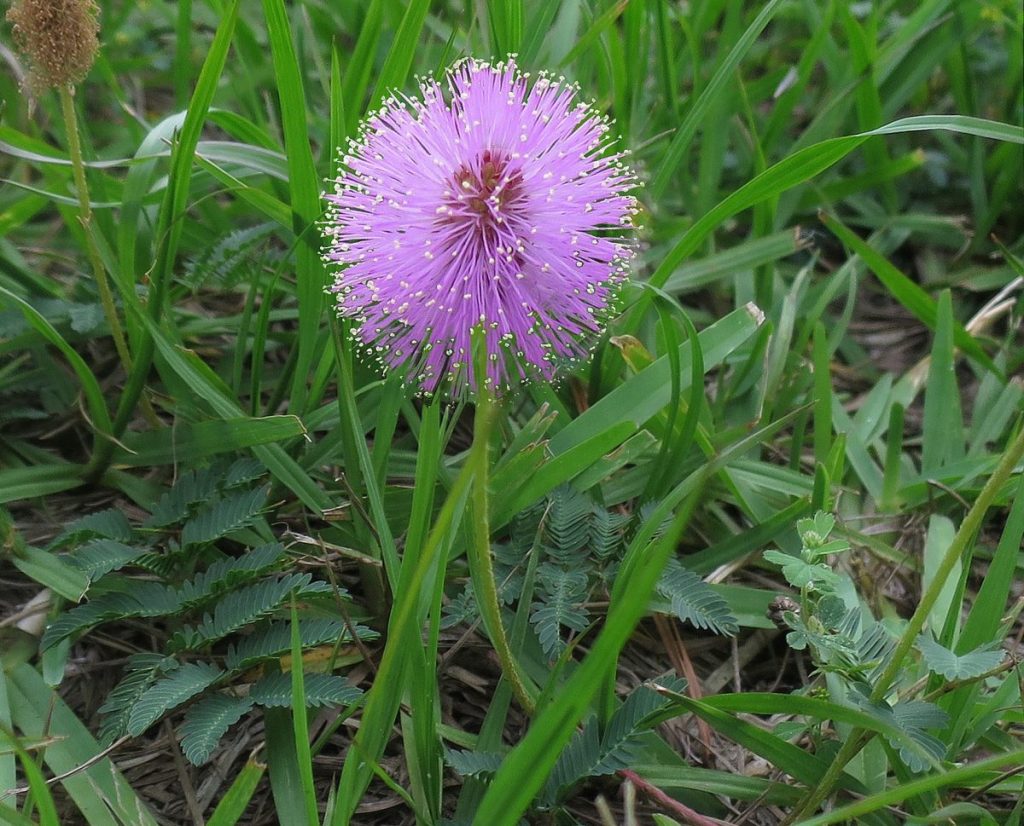
Powederpuff mimosa, a type of sensitive plant, growing in a lawn.
Your Lawn May Already Be Doing More Than You Think
Here’s a counterintuitive truth:
Many suburban lawns already contain butterfly host plants, even if no one planned it that way.
Different butterflies use different plant families — and many of those plants show up on their own.
For example, orange sulphur caterpillars feed on legumes — plants in the bean family. That includes:
• Clover
• Partridge pea
• Vetch
• Tick-trefoil
• Sensitive plant (mimosa)
Some of these are native wildflowers. Some are common lawn “weeds.”
Meanwhile, smaller species like the dainty sulphur use a different group of plants entirely —low-growing, easily overlooked plants, often from the aster family (ex. bidens, dogweed, greenthread and others) that show up in disturbed soil, along edges, or mixed into lawns.
These aren’t usually planted on purpose. They appear on their own — and are often removed before anyone realizes they’re being used.
If you’ve ever had clover patches, low leguminous volunteers, or edges that don’t get sprayed or mowed aggressively, your yard may already be usable habitat — even if it doesn’t look like a butterfly garden yet.
This is one reason people are often surprised by which butterflies show up first. The infrastructure is already there. The chemicals were the missing piece.
Why One Natural Yard Can Change an Entire Block
In many neighborhoods, there’s one yard that looks different.
Maybe it’s unmowed.
Maybe it has native plants.
Maybe it’s just… tolerated.
That single yard can function as a source habitat — a place where butterflies actually reproduce.
Surrounding lawns and gardens then become:
• Feeding areas
• Basking zones
• Safe transit space
You don’t need a whole street full of butterfly gardens for insects to move in. You need nodes.
When you stop spraying, your yard becomes a safe satellite — even if the host plants are technically across the street. That’s why people often notice butterflies before they’ve intentionally planted anything for them.
The network already exists.
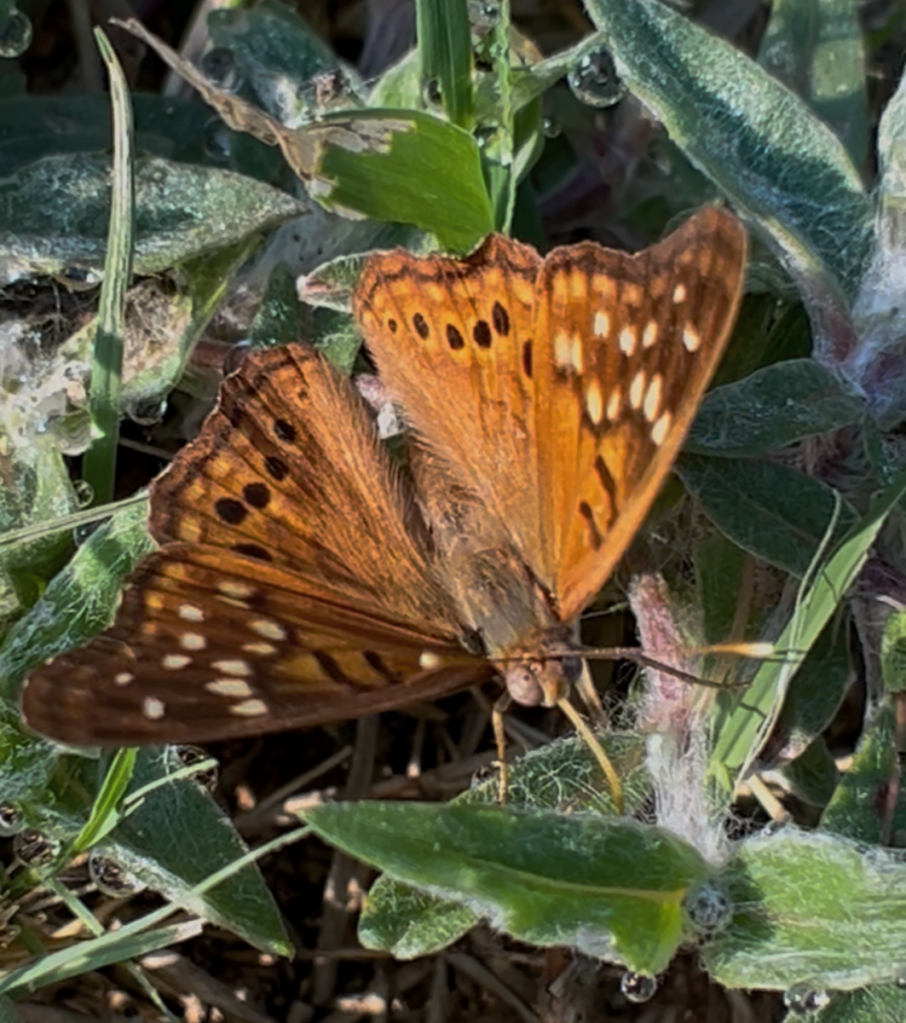
Hackberry emperor sipping dew from weeds in an untreated lawn.
Why This Phase Is Often Misunderstood
Many people assume that if they don’t see caterpillars right away, they’ve done something wrong.
In reality, they’re just early.
At this stage:
• Butterflies may be visiting but not breeding locally
• Eggs may be laid elsewhere
• Adults are still “sampling” the landscape
This is not failure.
It’s transition.
Your yard has moved from hostile to neutral.
The next step is becoming useful.
Small Changes That Move You Forward (Without Starting Over)
Small Changes That Move You Forward (Without Starting Over)
You don’t need to rip out your lawn or redesign everything to support this next phase.
Small, targeted changes work better.
1. Tolerate Some Legumes
Let clover or low-growing legumes stay where they appear. You don’t need large patches — even small areas matter.
2. Add One Intentional Host
Planting something like partridge pea or dwarf indigo quietly closes the life cycle loop. You don’t need a meadow. One or two plants is enough to start.
3. Leave Some Structure
Leaf litter, stems, and undisturbed edges provide shelter — especially important for overwintering insects.
4. Stay Consistent
The most important factor is time without spraying. Continuity builds trust.
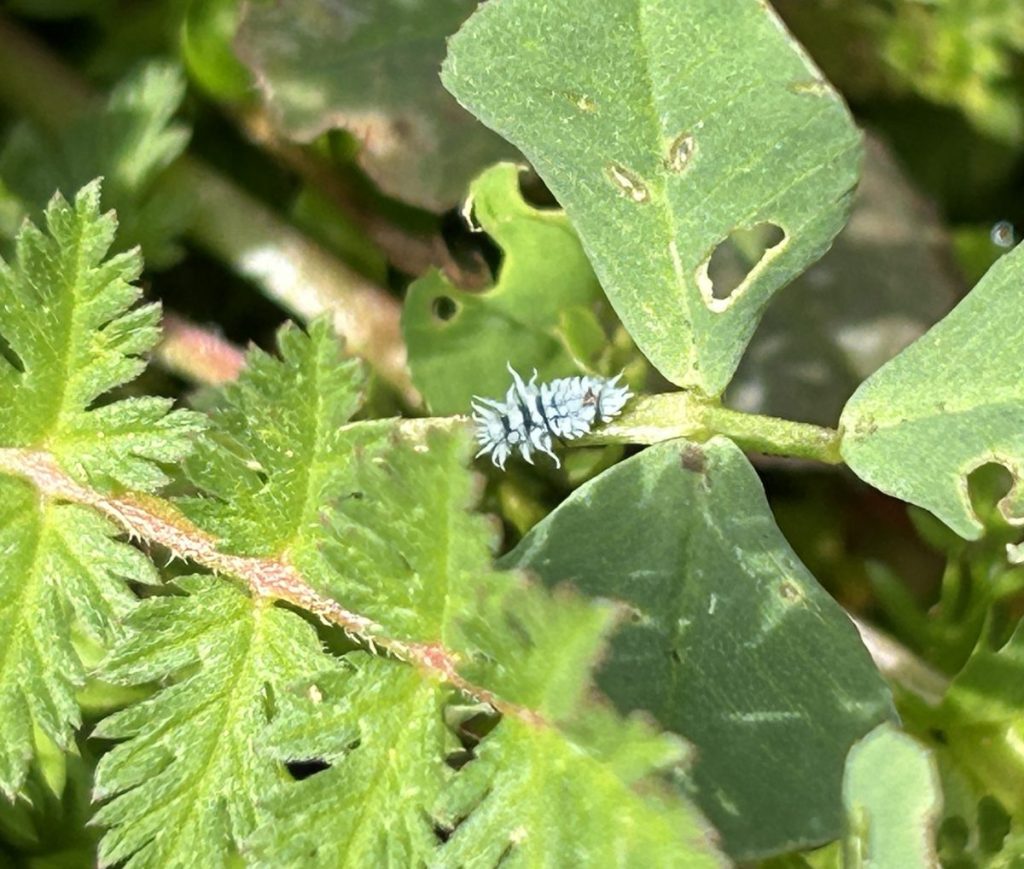
Lady beetle larvae on bur clover growing in a lawn. These predators of aphids often return in the first stages of recovery, right before butterfly larvae appear.
What Comes Next (But Not All at Once)
If you stay pesticide-free and gradually add host plants, the sequence usually continues like this:
• Repeat visits from the same small butterflies
• Females slowing down and testing plants
• Occasional caterpillars (often well hidden)
• Later-season diversity increasing year by year
This doesn’t happen in a single season.
It happens quietly, cumulatively.
And often, the first sign that something has shifted is a butterfly you almost didn’t notice.
Why This Matters More Than a Perfect Garden
Butterfly gardening isn’t a before-and-after transformation.
It’s a process of allowing life back in.
Stopping pesticide use is the single biggest step — larger than any specific plant choice — because it restores the possibility of relationship between insects and your yard.
If your space feels ordinary right now, that doesn’t mean it’s empty.
It may already be in use.
A Quiet Reframe
If you’ve stopped spraying and started noticing small, unremarkable butterflies — especially ones you didn’t plant for — that’s not disappointment.
That’s succession.
And it means your yard has crossed the first invisible threshold.
If this way of thinking about your garden is new, the Butterfly Garden Cheat Sheet shows how these small shifts come together to support butterflies over time.
Related Guides:
The Complete Guide to Butterfly Gardening: How to Attract, Feed, and Protect Butterflies All Year
The Best Host Plants for Caterpillars in Zone 8
Step-by-Step Butterfly Garden Setup for Spring in Texas
Photo credits: mimosa – Jim Evans, CC BY-SA 4.0, via Wikimedia Commons
 Butterfly garden paradise
Leave a comment