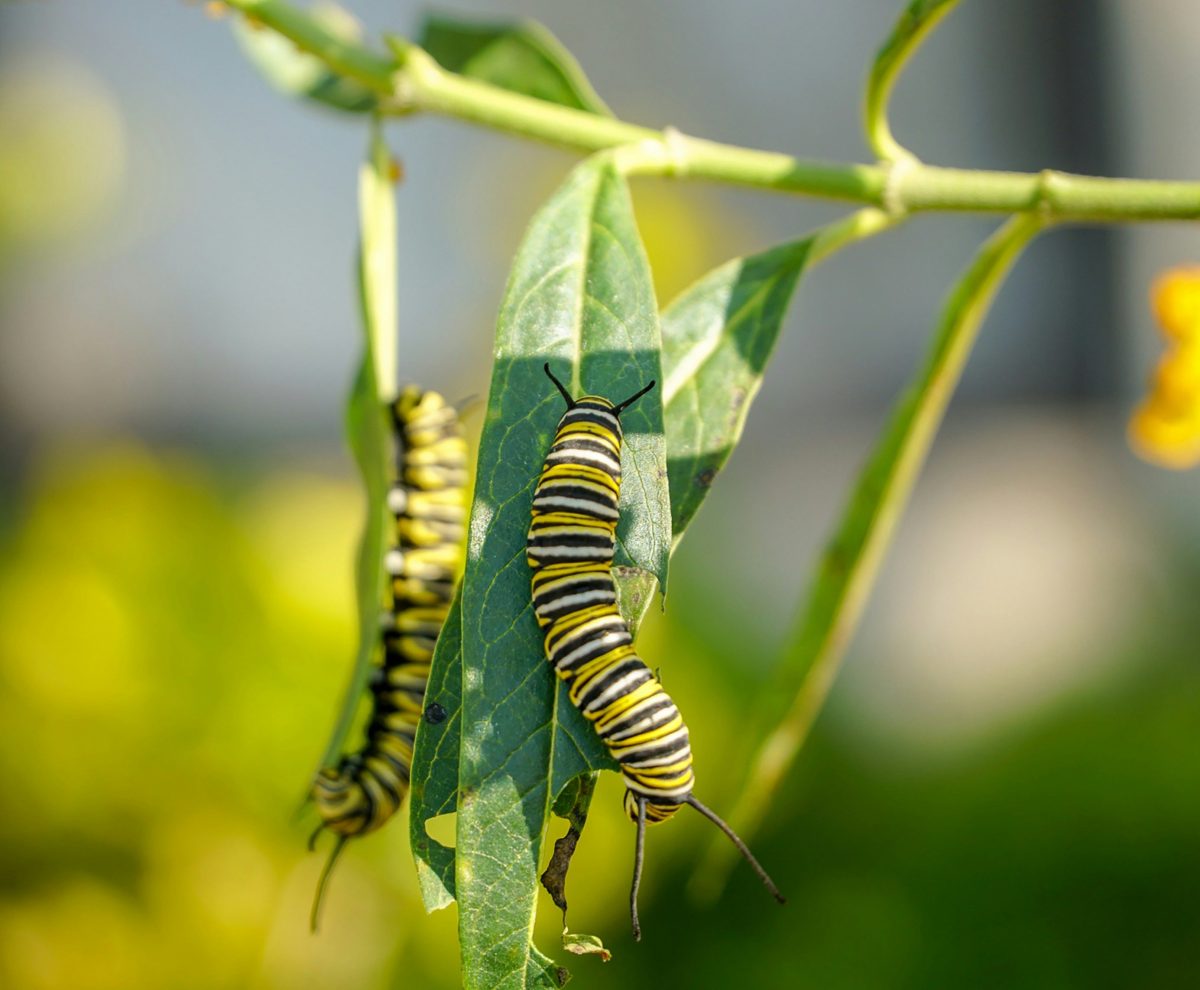
Cover photo: Monarch caterpillars feeding on milkweed leaves.
Finding caterpillars for the first time can be exciting—and unsettling.
Gardeners often notice chewed leaves, curled stems, or small insects tucked beneath foliage and immediately wonder whether something is wrong. The instinct to act is strong. Caterpillars feel both fragile and urgent.
In a butterfly garden, however, caterpillars are not a problem to solve. They are information.
Knowing what to do—and what not to do—when you find caterpillars in spring helps the garden settle into its role as habitat rather than display.
First: Pause Before You Intervene
Caterpillars are easy to misread.
They eat leaves. They appear suddenly. They don’t look decorative. In traditional gardening, these signs often trigger removal or treatment.
In butterfly gardens, the first and most important step is restraint.
Most caterpillars you find on appropriate host plants are exactly where they should be. Acting quickly—moving them, treating the plant, or cleaning up damage—often causes more harm than leaving them alone.
Confirm You’re Looking at a Host Plant
Before doing anything else, identify the plant the caterpillars are on.
Most butterfly caterpillars are host-specific. If caterpillars are feeding on:
- milkweed
- fennel
- dill
- citrus trees
- asters
- legumes
- passionvine
Their presence is usually intentional and beneficial.
If caterpillars are on a known host plant, feeding damage is not a sign of failure. It is a sign that the plant is being used as designed. See the best host plants for caterpillars in Zone 8.

Monarch caterpillar on a now mostly barren stem of milkweed.
Expect Leaf Damage—and Allow It
Caterpillars eat leaves. That’s their role.
In spring, host plants are often still establishing. Leaf loss can look dramatic even when the plant is not in danger.
Healthy host plants are adapted to this use. Temporary damage rarely harms long-term growth. In fact, allowing plants to support caterpillars often leads to stronger regrowth later in the season.
Removing caterpillars to “save the plant” usually undermines the purpose of planting the host in the first place.
Do Not Spray—Even Organic Treatments
When caterpillars appear, it can be tempting to reach for:
- neem oil
- insecticidal soap
- “organic” pest sprays
These products do not distinguish between pest insects and butterfly larvae.
Spraying host plants—especially during spring—often kills caterpillars directly or disrupts their ability to feed and develop. Even treatments labeled as gentle or natural can be lethal at this stage.
If the goal is to support butterflies, do not spray host plants.

Black swallowtail caterpillars moved to a potted host plant when they ran out of food.
Avoid Moving Caterpillars Unless Absolutely Necessary
Relocating caterpillars feels helpful, but it’s risky.
Caterpillars:
- are adapted to specific plants
- may not survive transfer
- can be exposed to predators during handling
If a caterpillar is on a suitable host plant and not in immediate danger, the safest option is to leave it where it is.
If relocation is unavoidable—such as during construction or pruning—move the caterpillar to the same species of host plant nearby and minimize handling. Cut the twig the caterpillars are on and let it crawl onto another stem to avoid harming them.
Provide Shelter by Doing Less
Caterpillars are vulnerable to heat, wind, and predators. Shelter matters.
You can support them by:
- leaving surrounding vegetation intact
- avoiding heavy pruning nearby
- allowing plant communities to remain layered
- leaving some leaf litter and stems in place
Host plants surrounded by other plants tend to support caterpillars more successfully than isolated specimens.
This is one reason caterpillars may be present but hard to see. Many feed at night or rest beneath leaves during the day.
Don’t Expect to See Them Constantly
Caterpillars are often invisible even when present.
They may:
- feed early in the morning or evening
- hide during the heat of the day
- blend into stems or leaves
- move between feeding and resting spots
Not seeing caterpillars doesn’t mean they’ve disappeared. It often means they are behaving normally.
Checking repeatedly can lead to unnecessary disturbance.

Birds are a natural predator of caterpillars but they are also a part of a healthy ecosystem.
Understand That Loss Is Part of the Process
Not every caterpillar will survive.
Predation, weather, and stress are part of natural systems. While it can be difficult to accept, loss does not mean the garden has failed.
Butterfly gardens work by supporting probability, not guaranteeing outcomes. Providing appropriate plants and conditions increases the chances that some caterpillars will complete their life cycle.
Trying to control every variable often reduces those chances rather than improving them.
What Not to Fix Right Away
When caterpillars appear, gardeners often worry about:
- uneven plant appearance
- chewed leaves
- plants looking stressed
- neighbors noticing “messiness”
These concerns are understandable, but most resolve naturally.
Plants regrow. Leaves are replaced. Activity shifts as the season progresses.
Correcting too quickly—by pruning, spraying, or replanting—interrupts processes that need time.
When to Step In (Rarely)
Intervention may be appropriate if:
- a host plant is newly planted and severely stressed
- extreme heat threatens survival
- caterpillars are at risk from human activity
In these cases, gentle shading, temporary protection, or careful relocation may help.
These situations are the exception, not the rule.

Gulf fritillary caterpillar on a passionflower stem. Its spines are actually not harmful but they do scare off predators.
What Caterpillars Signal About Your Garden
Finding caterpillars means:
- host plants are present and recognizable
- adult butterflies are using the space for reproduction
- the garden is supporting more than surface activity
This is a deeper level of success than seeing butterflies feed briefly.
Caterpillars indicate continuity.
A Calmer Way to Respond
When caterpillars appear, the most helpful response is often the simplest:
Leave the plant.
Leave the caterpillar.
Observe rather than correct.
Over time, this restraint builds confidence. The garden becomes less reactive and more predictable—not because it’s controlled, but because it’s understood.
Spring caterpillars are not a crisis.
They are a sign that the garden is beginning to function.
In these cases, gentle shading, temporary protection, or careful relocation may help.
These situations are the exception, not the rule.
If you want a simple way to understand which plants support each stage of the butterfly life cycle, the Butterfly Garden Cheat Sheet brings it together in one place.
Related Guides:
The Complete Guide to Butterfly Gardening: How to Attract, Feed , and Protect Butterflies All Year
The Best Host Plants for Caterpillars in Zone 8
How to Raise Black Swallowtail Caterpillars
Photo credits: cover monarch caterpillars – Thomas Park, bird with caterpillar – Brian Forsyth, gulf fritillary caterpillar – Ali Shah Lakhani
Leave a Reply